

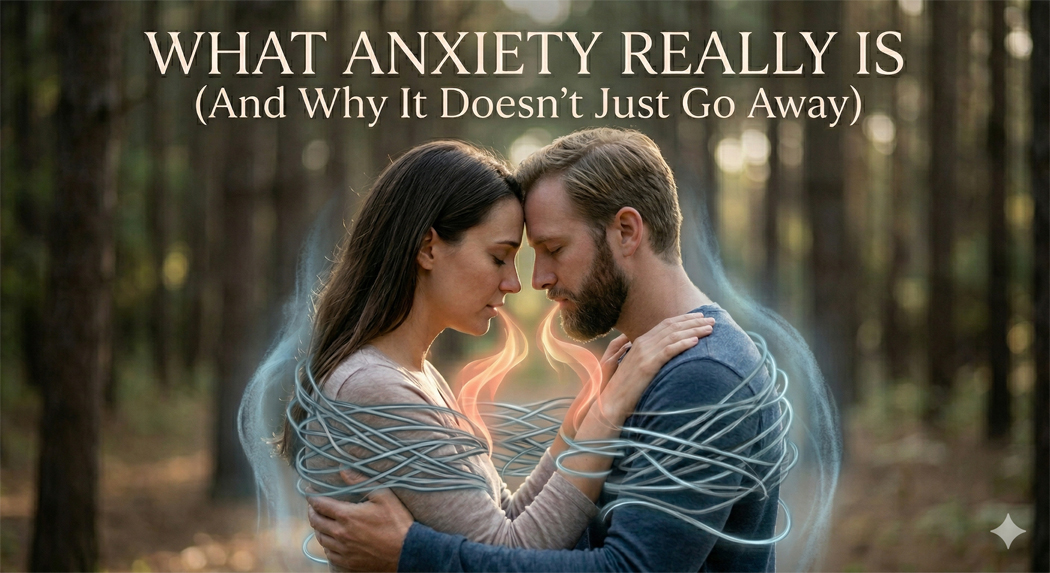
If anxiety has been lingering, even when you’ve tried to manage it, calm it, or make sense of it…
It can start to feel frustrating.
And sometimes, quietly… a little defeating.
Like:
“Why is this still happening?”
“I should be able to get a handle on this.”
“What am I missing?”
If you’ve had thoughts like that, I want to gently offer something right from the beginning:
You’re not failing at this.
And your anxiety isn’t sticking around because you’re doing something wrong.
Most of us are taught to approach anxiety by trying to control it.
To calm it down.
Think differently.
Push through it.
Get it to go away.
And sometimes that works… temporarily.
But often, it doesn’t fully touch what’s actually happening underneath.
Because anxiety isn’t just something you think.
It’s something your body is doing.
Anxiety Is a Nervous System State
Anxiety is your system activating.
It’s your body preparing, mobilizing energy in response to something it perceives as stress or threat.
And this part is important:
That activation isn’t the problem.
It’s actually your body doing exactly what it was designed to do.
But your body isn’t just built to activate…
It’s built to complete that activation.
Why Anxiety Doesn’t Go Away
When you don’t have the space to fully react in the moment …
when you have to stay composed, push through, or hold it together, your body adapts.
It holds onto the energy instead of releasing it.
Over time, that can start to feel like:
- Constant background anxiety
- Sudden spikes that don’t make sense
- Difficulty relaxing, even when things are “fine”
It’s not random.
It’s your system holding onto something that never got to fully move through.
A Different Way to Understand Anxiety
What if your anxiety isn’t something to get rid of…
But something that’s been waiting to move through you?
What if it makes sense, based on what your system has experienced and what it hasn’t had the chance to release?
This is often where the shift begins.
A Gentle Place to Start (1-Minute Practice)
Before trying to fix anything, just pause for a moment.
If it feels okay, take a breath in through your nose…and slowly out through your mouth.
Now ask yourself:
Where do I feel anxiety in my body right now?
There’s no right answer.
You might notice:
- Tightness in your chest
- A knot in your stomach
- Restlessness in your arms or legs
See if you can stay with that sensation for just a few seconds longer than you normally would.
Not trying to change it.
Not trying to make it go away.
Just noticing.
And then take one slightly deeper exhale.
That’s it.
This is how we begin.
Not by forcing calm…but by giving your body a little more space to do what it already knows how to do.
Why Thinking Isn’t Enough
A lot of anxiety tools focus on changing your thoughts.
And those can be helpful.
But if your body is still holding activation, your mind will keep trying to make sense of it.
That’s where the looping comes from. Your mind is trying to solve something your body hasn’t finished yet.
Anxiety in Relationships (And Why It Feels So Intense)
If you’re in a relationship, you may notice anxiety doesn’t just stay internal.
It shows up between you.
One of you might feel:
- Urgent
- Needing reassurance
- Wanting to talk it through now
While the other feels:
- Overwhelmed
- Shut down
- Needing space
And suddenly, you’re in a pattern that feels hard to interrupt.
This isn’t just communication.
This is two nervous systems interacting in real time.
How Breathwork Helps Release Anxiety
This is where somatic breathwork can be powerful.
Because breath gives your body a pathway to:
- Move stored energy
- Release physical tension
- Process emotions that didn’t have space before
Instead of forcing calm, it allows your system to complete stress responses that got interrupted.
How Couples Breathwork Can Help
When couples begin working with the body, not just the conversation, something shifts.
In couples breathwork, you’re not trying to “solve” the issue in the moment.
You’re learning how to:
- Regulate your own system
- Stay present while your partner is activated
- Move out of reaction and into awareness
Over time, this helps interrupt the cycle.
Because instead of escalating or shutting down, your systems begin to find a different rhythm.
There’s more space.
More choice.
Less automatic reactivity.
If You Want Support With This
I’ll be offering somatic breathwork later this summer, including sessions for individuals and couples.
If you’re curious about working with your anxiety in a more body-based way, or noticing patterns in your relationship that feel hard to shift, you’re welcome to reach out and join our waitlist.
There are ways to work with this that don’t involve forcing yourself to calm down.
And your system is capable of something different.